

Reliable networks begin with well-designed cabling. Commercial structured cabling is the physical backbone for data, voice, and video across offices and homes. This page summarizes benefits, local services in Roseville, and how to select a contractor to improve performance and reduce downtime.
Commercial structured cabling is the organized system of cables and hardware that carries voice, video, and data across a facility. Proper planning reduces troubleshooting, supports higher speeds, and makes future upgrades straightforward. Professional installation makes systems robust and ready for evolving technologies; local firms in Roseville offer commercial and residential projects that often include electrical, lighting, EV charging, and smart-home integrations.
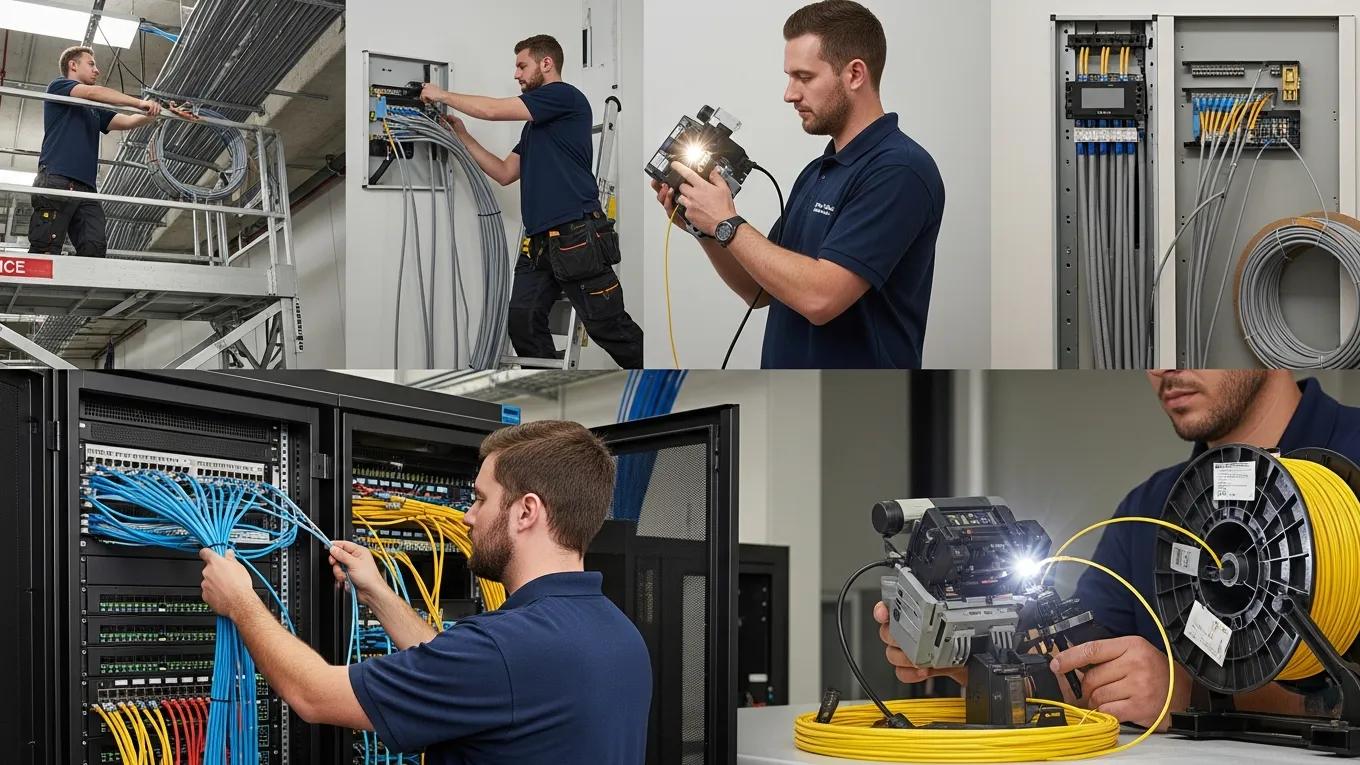
Local contractors provide a range of network cabling services to suit different needs. Typical services include:
Office cabling typically includes:
Retail networks are designed for each store’s layout and operations. Key considerations include:

Commercial wiring uses common cable types and transmission technologies to meet varied performance needs. Typical examples include:
| Cable Type | Technology | Application |
|---|---|---|
| Cat5e | Ethernet | Everyday data transmission for standard office networks |
| Cat6 | Ethernet | Higher-speed Ethernet for denser traffic and shorter runs |
| Fiber Optic | Light transmission | High-speed, long-distance links and backbone connections |
This table shows common cable choices and where they fit in commercial deployments.
Cat6 and fiber provide distinct advantages depending on the application:
Independent tests consistently show fiber delivers lower latency and fewer errors over distance, while Cat6 remains a cost-effective choice for many short-run installations.
Fiber vs. Copper (Cat6): Comparative Performance Evaluation This comparative study evaluates Fiber Ethernet against copper Ethernet (Cat6) using a controlled testbed. Identical endpoints were connected through a managed switch while the physical medium alternated between fiber and Cat6. Traffic patterns included TCP and UDP at three utilization levels (10%, 50%, and 90%) and three distance conditions (10 m, 50 m, and 90–100 m for Cat6). Measurements covered application- and interface-level metrics: TCP/UDP throughput, round-trip latency, jitter, packet loss, and reliability counters such as CRC/FCS errors and TCP retransmissions. At short distances and low load both media approach line-rate throughput, but fiber consistently shows lower latency and jitter with near-zero loss across test conditions. As utilization and distance grow, Cat6 exhibits larger delay variability and a higher tendency toward retransmissions and errors.
Yes. Structured cabling can centralize smart-home controls and EV charging infrastructure, providing:
Select contractors who demonstrate long-term performance and clear processes. Use these criteria:
Key capabilities to confirm:
Low Voltage Specialist LLC emphasizes workmanship and dependable service in Roseville. Their technicians are trained to current standards, follow structured evaluation and documentation processes, and provide post-install support so clients receive reliable systems and timely assistance.
Knowing local services and the role of structured cabling helps businesses and homeowners improve network reliability and scalability. Professional cabling reduces interruptions and positions sites for growth.
High-quality cabling usually lasts 15–25 years depending on environment and usage. Fiber and properly installed Cat6 often last toward the upper end. Regular inspections and timely upgrades keep performance steady.
Plan for capacity: deploy fiber where practical, leave extra pathways and pull-strings, and use modular racks and patch panels. Using higher-spec cable and working with informed contractors simplifies future upgrades.
Challenges include routing around existing infrastructure, meeting building codes, and avoiding disruption. Thorough site surveys and clear project plans with experienced crews prevent most problems.
Yes. Installations must comply with local building codes and national standards such as the NEC and TIA guidelines. Licensed contractors should secure required permits and follow these rules for safety and performance.
Perform visual inspections, check and tighten connections, and run periodic performance tests. Maintain accurate documentation of cable routes and termination points for easier troubleshooting and changes.
Consider an upgrade if you experience frequent outages, slow speeds, or difficulty supporting new devices. If your infrastructure is older than 10–15 years or not meeting current needs, get a professional assessment to plan the right path.
Investing in professional structured cabling in Roseville delivers a stable, scalable network foundation that supports productivity and future technology. With thoughtful design, quality installation, and reliable support — attributes emphasized by Low Voltage Specialist LLC — your infrastructure will perform today and adapt tomorrow. Contact a qualified installer to evaluate your site and plan a solution that fits your goals.
Reliable networks begin with well-designed cabling. Commercial structured cabling is the physical backbone for data, voice, and video across offices and homes. This page summarizes benefits, local services in Roseville, and how to select a contractor to improve performance and reduce downtime.
Monday – Friday: 7:00 AM – 6:00 PM
Saturday-Sunday: 8:00 AM – 5:00 PM